Transmission Service Springfield, MO
Delayed engagement, slipping, harsh or erratic shifts, shudder, fluid leaks, warning lights, overheating, or unusual transmission noise require correct testing. Crown Auto Sales & Service identifies the system and condition before recommending service or repair.
Why Proper Transmission Diagnosis Matters
Shift and engagement symptoms can come from fluid level, leaks, engine performance, mounts, axles, wheel-speed inputs, wiring, solenoids, valve bodies, software, clutch controls, torque converters, or internal wear. Testing helps prevent incorrect service or major repair.
Transmission Problems We Diagnose
Fluid Leaks or Incorrect Level
Pan seals, cooler lines, axle seals, case seals, connectors, vents, and related components can leak or affect fluid level.
Delayed Engagement or Slipping
Low fluid, pressure loss, valve-body faults, solenoids, clutch wear, converter issues, or internal damage can delay or reduce apply.
Harsh or Erratic Shifting
Adaptations, sensor inputs, engine faults, hydraulic controls, solenoids, software, mounts, or internal wear can change shift quality.
Shudder or Vibration
Torque-converter clutch, CVT, clutch, fluid, mounts, axles, tires, engine operation, or driveline faults can feel similar.
Overheating
Low fluid, restricted cooler flow, heavy load, cooling faults, slipping, pressure problems, or internal wear can raise temperature.
Electrical or Control Faults
Speed sensors, range sensors, solenoids, wiring, modules, grounds, voltage, software, or network faults can affect operation.
Transmission Symptoms and Possible Causes
| What You Notice | Possible Cause | Why It Matters |
|---|---|---|
| Delayed Drive or Reverse engagement | Fluid level, pressure, valve body, solenoid, clutch, converter, control, or internal concern | Fluid, data, pressure, and operating condition must be checked |
| Slipping or flare during shifts | Low fluid, pressure loss, clutch wear, solenoid, valve body, converter, or internal damage | Continued slip can create heat and additional damage |
| Shudder, vibration, or unusual noise | Adaptation, sensor input, engine fault, solenoid, hydraulic control, software, mount, or internal wear | Scan data and road testing help separate control and mechanical faults |
| Shudder or vibration | Torque-converter clutch, CVT, clutch, fluid, mount, axle, tire, or engine concern | The source must be isolated before transmission repair |
| Fluid leak or burnt odor | Pan, seal, cooler line, connector, vent, overheating, or internal wear | Fluid level and leak source require the correct procedure |
| Warning light or fail-safe mode | Sensor, wiring, solenoid, ratio, pressure, temperature, module, voltage, or mechanical fault | Codes and operating data guide further testing |
Automatic, CVT and Manual Systems
The correct fluid, service procedure, testing method, and repair scope depend on the exact transmission design. Conventional automatics, CVTs, dual-clutch units, automated manuals, and manual transmissions use different components and requirements.
Common Transmission Types and Service Scopes
- Fluid, filters, pumps, torque converters, and coolers
- Valve bodies, solenoids, sensors, and hydraulic circuits
- Planetary sets, belts, chains, pulleys, and clutch elements
- Programming, adaptations, and application-specific procedures
Manual and Clutch Systems
- Clutch disc, pressure plate, release system, and flywheel
- Hydraulic master/slave cylinders, cables, and linkages
- Synchronizers, gears, bearings, shafts, and differential
- Correct gear oil or fluid and manufacturer procedures
What Transmission Diagnosis May Include
Scan and Shift Data
Codes, freeze-frame data, commanded gear, ratio, slip, input/output speeds, temperature, pressure commands, and adaptation values provide direction.
Fluid Level and Condition
The correct temperature, procedure, fluid specification, level, color, odor, debris, aeration, and contamination are evaluated.
Leak and Cooler Inspection
Pan, seals, connectors, cooler, lines, fittings, radiator interface, and case areas are checked for leakage or damage.
Electrical and Solenoid Testing
Power, grounds, wiring, connectors, sensors, solenoids, modules, network communication, and commands may require testing.
Pressure and Mechanical Testing
Line pressure, clutch apply, stall behavior, noise, debris, end play, or internal inspection may be needed when appropriate.
Road Test and Symptom Reproduction
Shift timing, engagement, slip, shudder, temperature, noise, load, speed, and operating conditions are compared with scan data.
How We Handle Transmission Service
Review Symptoms
We review shift symptoms, engagement, leaks, warnings, temperature, towing or load, prior service, mileage, and failure conditions.
Inspect the System
We inspect fluid and leaks, cooler lines, wiring, connectors, mounts, axles, related components, and visible transmission condition.
Test and Isolate
We use scan data, circuit tests, fluid checks, pressure tests, road testing, noise isolation, and mechanical inspection as appropriate.
Verify Repair
After approved service or repair, fluid, leaks, temperature, engagement, shifting, adaptations, warning lights, and road behavior are checked.
Transmission Maintenance May Include
- Manufacturer interval and service-history review
- Correct fluid specification and service procedure
- Fluid drain and fill or pan service when appropriate
- Filter, pan, gasket, magnet, and debris inspection
- Cooler line and leak inspection
- Manual transmission or differential fluid service
- Required adaptations or relearn procedures
- Post-service operation and leak check
Transmission Repair May Include
- Pan, seal, connector, cooler, or line repair
- Sensor, wiring, solenoid, or control repair
- Valve-body or hydraulic-control repair
- Torque-converter or clutch-system repair
- Internal transmission repair or overhaul
- Used or remanufactured unit replacement when justified
- Programming, coding, setup, or adaptation
- Final fluid, leak, temperature, and road verification
Fluid Service Versus Transmission Flush
A drain-and-fill or pan service replaces part of the fluid and may allow filter, pan, magnet, and debris inspection. A fluid-exchange process replaces more fluid. Neither procedure repairs worn clutches, failed solenoids, pressure loss, valve-body damage, or other existing faults.
- Identify the exact transmission and required fluid
- Review condition, history, symptoms, and service information
- Inspect for leaks, overheating, debris, and contamination
- Choose the appropriate approved service method
Repair, Rebuild or Replacement
External leaks and control faults may be repairable without replacing the unit. Widespread internal wear, hard-part damage, contamination, parts availability, vehicle use, and warranty options can affect whether repair, overhaul, or replacement is practical.
Can I Drive With a Transmission Problem?
Continued driving with slipping, delayed engagement, fluid loss, overheating, grinding, severe shudder, or reduced control can create additional damage or a safety risk.
- Stop driving if the vehicle will not engage or maintain power reliably
- Do not continue with rapid transmission-fluid loss or visible smoke
- Stop safely for severe grinding, shudder, binding, or overheating warnings
- Avoid towing or heavy load when the transmission slips or runs hot
- Address fail-safe operation and flashing warning indicators promptly
- Use towing when shifting, vehicle movement, or fluid loss makes driving unsafe
What Affects Transmission Service Cost and Time?
Transmission Type
Conventional automatic, CVT, dual-clutch, automated manual, and manual transmissions require different fluids, filters, tests, and procedures.
Symptom and Failure Type
A fluid leak, electrical fault, valve-body problem, pressure loss, torque-converter concern, clutch wear, or internal damage requires a different scope.
Diagnostic Requirements
Code analysis, scan data, pressure testing, electrical checks, road testing, adaptation review, fluid inspection, or teardown may be required.
Fluid, Filter and Parts
Application-specific fluid, pan or external filters, gaskets, seals, solenoids, valve bodies, coolers, hardware, and internal parts affect cost.
Repair or Replacement Path
External repair, valve-body service, internal repair, rebuild, used unit, remanufactured assembly, or new OEM replacement differ in scope and warranty.
Programming and Related Systems
Software updates, adaptive relearn, module programming, cooler flushing, mounts, wiring, engine inputs, and drivetrain faults can change the project.
Transmission Service With Clear Answers
Correct System Identification
We identify the exact transmission, fluid, service procedure, symptoms, codes, and operating data before recommending work.
Complete Driveline Review
We consider engine operation, mounts, axles, coolers, wiring, controls, software, fluid condition, and internal transmission evidence.
Clear Repair Options
We explain findings, repair scope, replacement choices, related needs, and the next step before approved work begins.
Related Automotive Service Pages
Transmission Service Near Springfield, MO
Serving Springfield, Nixa, Ozark, Republic, Strafford, Rogersville, Battlefield, and nearby Southwest Missouri communities.
Transmission Service Frequently Asked Questions
How often should transmission fluid be serviced?
Follow the manufacturer schedule for the exact transmission and fluid. Vehicle use, towing, heat, prior service, leaks, symptoms, and fluid condition may affect the recommendation.
Is a transmission fluid exchange the same as a repair?
No. An exchange replaces fluid but does not repair worn clutches, failed solenoids, pressure loss, valve-body damage, torque-converter faults, or broken internal parts.
Can new transmission fluid cause a failure?
Correct fluid service does not create existing mechanical wear, but service method and risk should be evaluated when a transmission already slips, has severe debris, overheats, or has an unknown history.
Why is my transmission slipping or shifting hard?
Possible causes include fluid level or condition, leaks, control inputs, solenoids, valve body, pressure loss, adaptations, software, torque converter, clutch wear, or internal damage.
Does a transmission code mean the transmission must be replaced?
No. Codes identify a circuit, condition, ratio, pressure, temperature, or performance problem. Wiring, sensors, engine inputs, controls, fluid, and mechanical operation must be tested.
Do CVTs use regular automatic transmission fluid?
Not necessarily. CVTs and other transmission designs often require application-specific fluid. Using an incorrect fluid can affect operation and component life.
Need Transmission Service in Springfield, MO?
Schedule transmission diagnosis, maintenance, or repair with Crown Auto Sales & Service.
Crown Auto Sales & Service
1419 E Kearney St, Springfield, MO 65803
Phone: (417) 771-5435
🔧 Transmission Service in Springfield, MO – Maintain Smooth Shifts & Maximize Lifespan
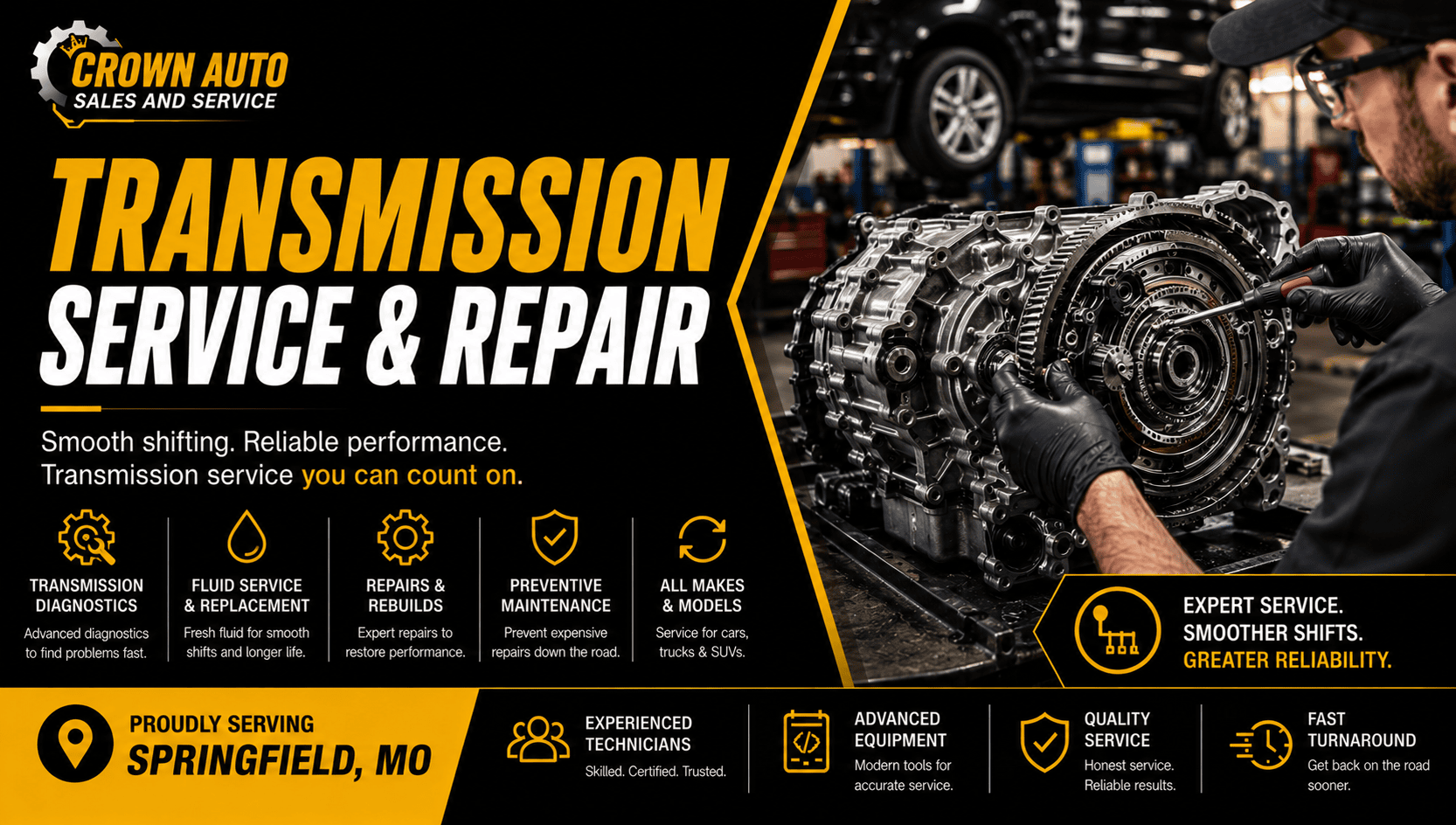
Your vehicle’s transmission is one of its most critical components. Over time, fluids degrade, filters clog, and wear begins unnoticed. At Crown Auto Sales & Service, we provide professional transmission service in Springfield, MO to keep your drivetrain operating smoothly and reliably — whether it’s automatic, CVT, DCT, or manual.
- Fluid & filter replacement or inspection — essential lubricant & hydraulic fluid, crucial for proper shifting.
- Transmission pan & gasket check — removed/inspected for metal particles, wear, and fluid condition.
- Fluid quality & condition evaluation — fluid colour, smell and wear tell us much about internal health.
- Service interval recommendation based on driving conditions — “normal” vs “severe” usage.
- Road test and system check after service — ensure no slipping, rough shifting or unusual noises remain.
Visit us at 1419 E Kearney St, Springfield, MO 65803 — conveniently located off I-44. Click below for directions or call to schedule your transmission service appointment.
Shifting issues? Let Crown Auto fix it before it becomes a full breakdown.
