
Starter Repair Springfield, MO
A click, slow crank, intermittent no-crank, or starter that stays engaged can involve the battery, cables, grounds, starter motor, solenoid, relay, ignition switch, security system, module command, or engine mechanical load. Crown Auto Sales & Service tests the starting system before recommending replacement.
Starting-System Testing With Clear Answers
Whole-Circuit Testing
Battery delivery, cables, grounds, starter motor, solenoid, relay, controls and mechanical load are evaluated together.
Loaded Measurements
Cranking voltage, current draw and positive/ground voltage drop reveal faults that visual checks miss.
Clear Recommendations
We explain whether the confirmed need involves the starter, battery, connection, control circuit, security system or mechanical engagement.
Starter Problems We Diagnose
Starter Motor Wear
Brushes, commutator, bearings, windings, armature, drive, or internal contacts can fail.
Solenoid or Relay Fault
Contacts, coils, relay control, terminals, or high-current connections may prevent engagement.
Battery Delivery Problem
A weak battery may show voltage but lack capacity to supply starter current.
Cable or Ground Resistance
Corrosion, loose terminals, broken strands, or poor grounds create voltage drop under load.
Control Circuit Fault
Ignition switch, start button, park/neutral switch, clutch switch, wiring, fuse, or module command may fail.
Mechanical Engagement Issue
Flywheel teeth, starter alignment, mounting, engine drag, or a locked engine can imitate starter failure.
Starting Symptoms and Possible Causes
| What You Notice | Possible Cause | Why It Matters |
|---|---|---|
| Single click, no crank | Battery delivery, cable resistance, solenoid, starter motor, or locked engine | A click does not prove the starter is bad |
| Rapid clicking | Low battery voltage, weak capacity, loose terminal, or high resistance | Voltage may collapse only under starter load |
| Slow cranking | Battery, cables, starter current draw, cold oil, or engine mechanical load | Cranking voltage and current should be tested together |
| No sound or response | Start command, fuse, relay, switch, security, network, wiring, or starter fault | The control circuit must be checked |
| Grinding or free-spinning | Starter drive, flywheel teeth, alignment, mounting, or incorrect part | Continued attempts can damage engagement components |
| Starter remains engaged | Solenoid, relay, wiring, switch, mounting, or drive fault | Stop the engine to prevent severe starter and flywheel damage |
Power Delivery and Start Command
The starter needs both a high-current path from the battery and a valid control command from switches, relays, security systems, and modules.
High-Current Circuit
- Battery capacity under cranking load
- Positive-cable voltage drop
- Engine and body ground voltage drop
- Starter current draw and mechanical load
Control and Engagement
- Start request and module authorization
- Relay, solenoid and switch operation
- Park/neutral or clutch-switch inputs
- Starter drive, flywheel teeth and mounting
Testing Before Starter Replacement
Verify the Symptom
Clicking, speed, sound, temperature, gear position and intermittent conditions are documented.
Test Battery Capacity
State of charge and available capacity are evaluated before judging starter performance.
Measure Voltage Drop
Positive and ground paths are tested while the starter circuit carries current.
Measure Starter Draw
Cranking current, voltage and speed help identify electrical or mechanical load problems.
Check the Start Command
Fuses, relay, switches, security authorization, wiring, and module outputs are checked as needed.
Inspect Engagement
Drive operation, flywheel teeth, mounting, alignment and abnormal sounds are evaluated.
How We Diagnose and Repair Starting Problems
Verify
We reproduce and document the no-crank, slow-crank, clicking, or noise concern.
Load Test
Battery capacity, cables, grounds, starter current and cranking voltage are measured.
Control Test
Start request, relay, solenoid, switches, wiring and authorization are checked.
Repair and Verify
After approval, the confirmed fault is repaired and starting operation is retested.
Starter Service May Include
- Battery state-of-charge and capacity testing
- Cranking voltage and starter-current testing
- Positive and ground voltage-drop testing
- Starter relay and solenoid checks
- Start-command and switch testing
- Security and network evaluation when relevant
- Starter mounting and engagement inspection
- Post-repair starting verification
Possible Related Repairs
- Starter motor or assembly replacement
- Starter solenoid or relay repair
- Battery terminal, cable or ground repair
- Battery replacement when confirmed
- Fuse, connector or control-circuit repair
- Park/neutral or clutch-switch repair
- Flywheel or flexplate diagnosis
- Security or module diagnosis
Clicking Does Not Always Mean Starter Failure
Low battery capacity or resistance in a terminal, cable, ground, relay, or solenoid can create the same symptom.
- Test voltage while the start request is active
- Measure voltage drop on both sides of the circuit
- Compare starter current with cranking speed
- Confirm the engine can rotate mechanically
Intermittent No-Crank Concerns
Heat, vibration, gear position, worn contacts, security authorization, relay operation, or a weak connection may affect when the fault appears.
Is It Safe to Keep Trying the Starter?
Repeated or extended cranking can overheat the starter, cables, solenoid, battery, and connections.
- Stop if cables, terminals, or the starter become hot
- Stop for smoke, burning odor, grinding, or a starter that stays engaged
- Do not bypass safety or security circuits
- Keep the vehicle secured in Park or Neutral during testing
- Use towing when reliable starting or safe electrical operation is uncertain
What Affects Starter Repair Cost and Time?
Starter Location
Intake, exhaust, shields, driveline or other components may limit access.
Starter Design
Conventional, gear-reduction, integrated, start-stop and hybrid systems differ.
Failure Type
Motor, solenoid, relay, wiring, cable, switch, security, or mechanical faults require different repairs.
Related Damage
Heat-damaged cables, flywheel teeth, oil contamination, loose mounting or corrosion may add work.
Diagnostic Time
Intermittent no-crank or network-controlled faults may require extended testing.
Vehicle Configuration
Engine layout, four-wheel drive, diesel, hybrid and multiple-battery systems affect procedure.
Why Starter Diagnosis Matters
Clicking, slow cranking, or no-crank operation can come from insufficient battery capacity, cable resistance, missing start authorization, a failed relay or solenoid, starter wear, damaged flywheel teeth, or an engine that cannot rotate normally.
Related Automotive Service Pages
Starter Repair Near Springfield, MO
Serving Springfield, Nixa, Ozark, Republic, Strafford, Rogersville, Battlefield, and nearby Southwest Missouri communities.
Starter Repair Frequently Asked Questions
Does one click mean the starter is bad?
No. Low battery capacity, cable resistance, a relay, solenoid, ground, or locked engine can also cause one click.
Why does the starter work sometimes?
Heat, worn contacts, loose connections, relay or switch faults, security authorization, or vibration may create an intermittent no-crank.
Can a bad battery damage a starter?
Low voltage and repeated long cranking can increase heat and stress in the starting circuit.
Why test starter current draw?
Current, cranking voltage, and speed together help separate electrical resistance, starter faults, and excessive engine load.
Can a security problem prevent cranking?
Yes. Some vehicles require valid key recognition and module authorization before the starter is commanded.
Should the battery be tested with the starter?
Yes. Battery capacity and power delivery must be known before starter performance can be judged accurately.
Need Starter Repair in Springfield, MO?
Schedule starting-system diagnosis and starter repair with Crown Auto Sales & Service.
Crown Auto Sales & Service
1419 E Kearney St, Springfield, MO 65803
Phone: (417) 771-5435
Related Services
- Battery & Electrical Repair
- Alternator Repair
- Diagnostic Service
- Check Engine Light Service
- Financing Options
- Warranty Information
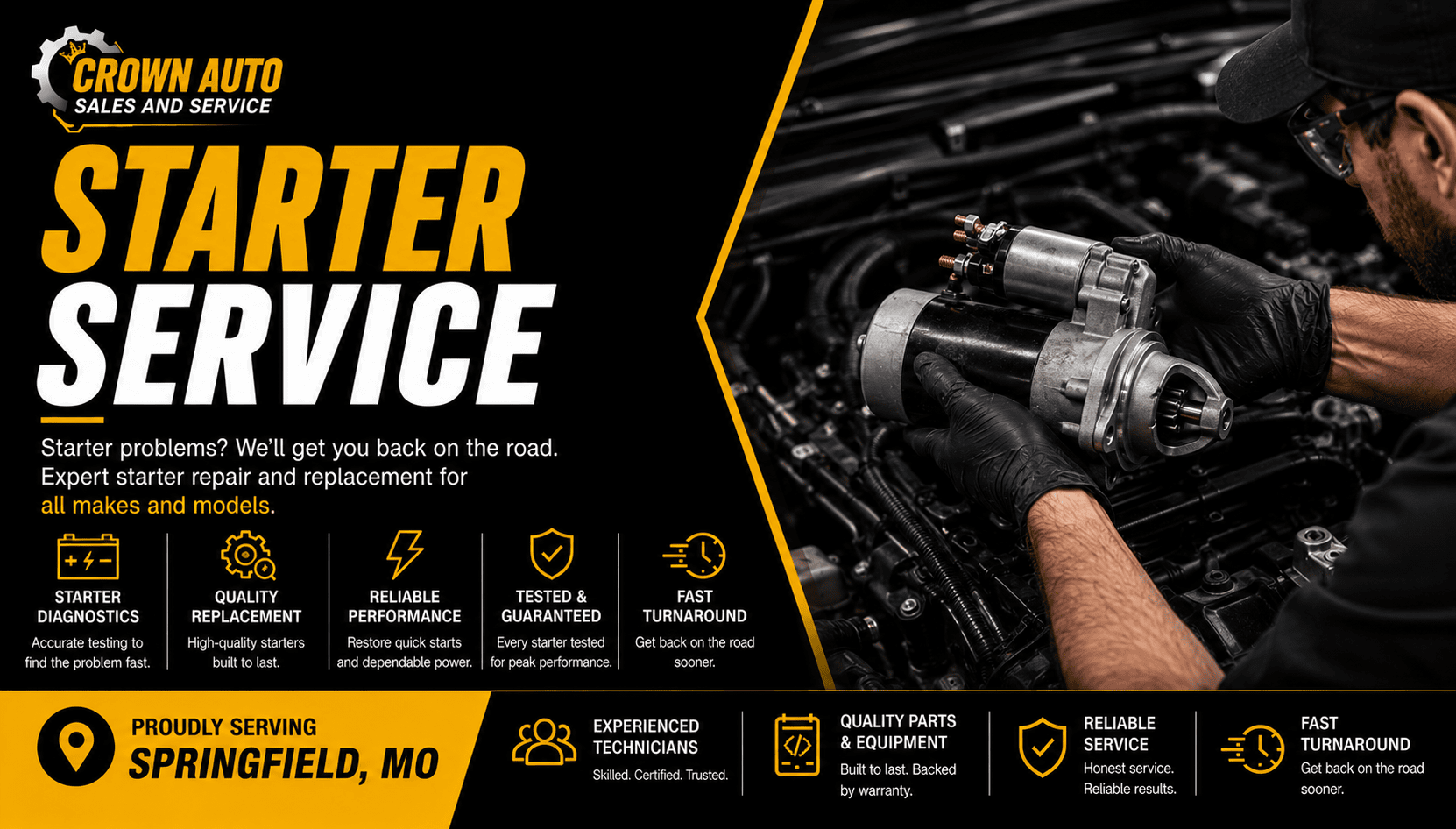
🔋 Starter Repair in Springfield, MO – Fast, Reliable No-Start Diagnostics
If your vehicle clicks but won’t crank, or the engine struggles to start, it may be time for a professional starter repair in Springfield, MO. At Crown Auto Sales & Service, our ASE-certified technicians quickly pinpoint the problem — whether it’s the starter motor, solenoid, ignition switch, or wiring — and get you back on the road fast.
- Complete starting-system diagnostics — battery, alternator, and starter testing
- Starter replacement or rebuild using OEM-grade or high-quality remanufactured parts
- Electrical and wiring inspection to locate loose grounds or corroded terminals
- Ignition-switch and relay testing to ensure proper voltage delivery
- Post-repair verification — voltage drop test and start-up performance check
Visit us at 1419 E Kearney St, Springfield, MO 65803 — just off I-44. Call or click below to schedule your no-start diagnostic today.
No more clicking. No more guessing. Just a reliable start — every time.
Want to learn more about our full range of automotive services? Head over to our homepage to schedule an appointment, view promotions, or explore other services like engine, transmission, oil changes, engine diagnostics, brake repair, and more!
