
ABS Repair Springfield, MO
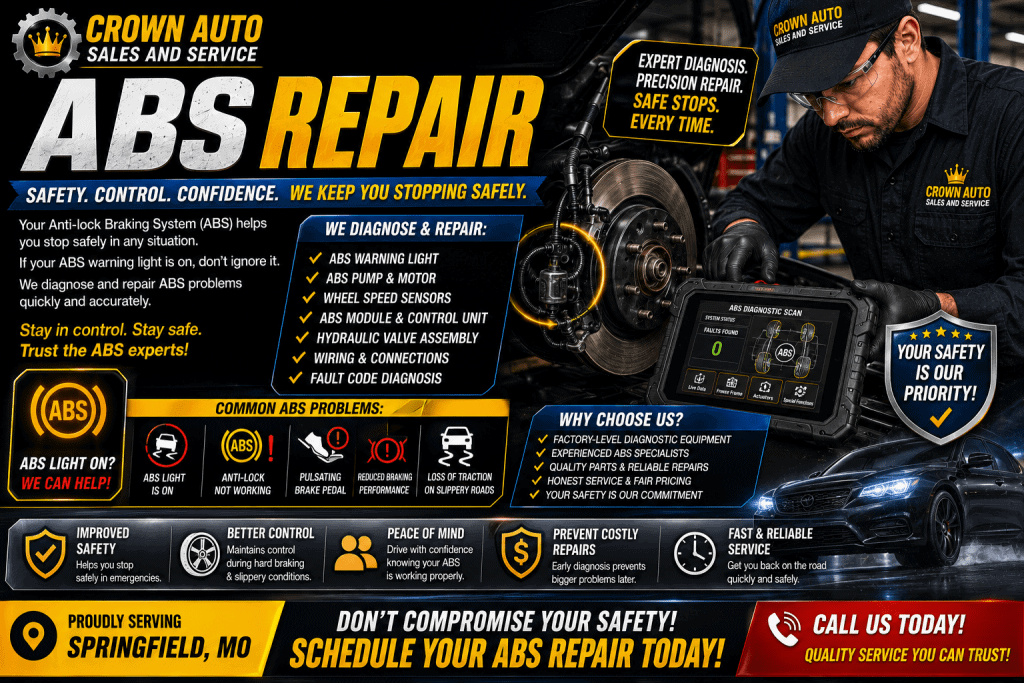
An ABS, traction-control, or stability warning, false ABS activation, wheel-speed faults, pump noise, communication codes, or disabled electronic brake functions require system-level testing. Crown Auto Sales & Service diagnoses the fault before recommending parts.
Why Proper ABS Diagnosis Matters
An ABS code identifies a monitored circuit or operating condition, not automatically a failed sensor or module. Tone rings, bearing play, tire size, voltage, wiring, connectors, hydraulic faults, network communication, calibration, and mechanical brake condition can create similar warnings.
ABS Problems We Diagnose
Wheel-Speed Sensor Faults
Open or shorted circuits, internal sensor faults, incorrect air gaps, debris, physical damage, or magnetic contamination can affect signals.
Tone Ring or Encoder Damage
Cracks, rust, missing teeth, damaged magnetic encoders, incorrect bearings, axle damage, or excessive runout can distort wheel-speed data.
Harness and Connector Problems
Chafing, corrosion, water entry, loose terminals, stretched wiring, poor routing, or prior repair damage can interrupt sensor and module circuits.
Hydraulic Pump or Valve Faults
Pump motors, relays, valves, accumulators, pressure sensors, internal leakage, air, or contamination can affect hydraulic modulation.
Module, Voltage or Network Faults
Low voltage, grounds, power feeds, internal module faults, programming, configuration, or communication problems can disable ABS functions.
Input and Calibration Faults
Steering-angle, yaw-rate, lateral-acceleration, brake-pressure, pedal, wheel-size, alignment, or ride-height data may require testing or calibration.
ABS Symptoms and Possible Causes
| What You Notice | Possible Cause | Why It Matters |
|---|---|---|
| ABS warning stays on | Wheel-speed sensor, tone ring, encoder, wiring, voltage, module, pump, valve, calibration, or mechanical brake concern | Codes and live data guide system testing |
| ABS activates at low speed | Dropping wheel-speed signal, encoder damage, tone-ring crack, bearing play, sensor gap, wiring, tire, or axle concern | Graphing all wheel speeds can reveal the signal dropout |
| Wheel-speed signal drops out or disagrees | Sensor circuit, encoder, tone ring, air gap, connector, wiring, bearing, axle, tire size, or module input | Circuit and mechanical evidence must be compared |
| ABS pump runs or will not run | Motor, relay, fuse, power, ground, module driver, internal hydraulic fault, pressure condition, or command | Bidirectional and circuit testing may be required |
| Communication code with ABS module | Power, ground, network wiring, connector, module, voltage, gateway, or configuration concern | Network diagnosis is required before module replacement |
| Traction or stability warning with ABS light | Shared wheel-speed data, steering angle, yaw, pressure, module, voltage, network, tire, alignment, or calibration concern | Related systems should be scanned together |
Sensors, Hydraulic Control and Vehicle Dynamics
ABS monitors wheel speed and driver or vehicle inputs, then modulates hydraulic pressure to help prevent wheel lock. Traction and stability systems may also request engine torque reduction or individual braking. Reliable repair requires electrical, hydraulic, mechanical, network, and calibration checks.
Common ABS and Stability-Control System Scopes
- Active or passive wheel-speed sensors and circuits
- Tone rings, magnetic encoders, hubs, bearings, and axles
- Tire size, inflation, tread depth, alignment, and suspension
- Steering angle, yaw, acceleration, and pressure inputs
Hydraulic and Electronic Controls
- ABS hydraulic control unit, pump, motor, and valves
- Power, grounds, fuses, relays, wiring, and connectors
- ABS, stability, powertrain, steering, and body modules
- Programming, coding, configuration, and calibrations
What ABS Diagnosis May Include
Full-System Scan
ABS, brake, stability, powertrain, steering, and related modules are scanned for codes, status, freeze-frame information, and communication faults.
Live Wheel-Speed Data
Individual wheel speeds are compared through acceleration, deceleration, turns, low speed, and relevant operating conditions when safe.
Circuit and Signal Testing
Power, ground, resistance, voltage, waveform, bias, frequency, network, terminal fit, and harness integrity may require testing.
Tone Ring and Wheel-End Inspection
Encoders, tone rings, hubs, bearings, axles, sensor gaps, debris, runout, tire size, wheel fit, and mechanical play are inspected.
Hydraulic Unit Testing
Pump commands, valve operation, relays, motor circuits, pressure sensors, fluid, air, leaks, and scan-tool bleeding functions may be tested.
Calibration and Road Verification
After approved repair, codes, live data, warning lamps, calibrations, ABS activation, traction/stability operation, pedal feel, and road behavior are verified.
How We Handle ABS Repair
Review Symptoms
We review warning lights, false activation, pedal behavior, weather, speed, recent bearing or axle work, tire changes, alignment, battery condition, prior repairs, and fault history.
Scan and Inspect
We perform a full-system scan and inspect sensors, wiring, tone rings, encoders, hubs, bearings, tires, hydraulic components, power, grounds, and visible damage.
Test and Isolate
We compare live data and use circuit, waveform, network, hydraulic, command, mechanical, and road tests as appropriate.
Repair and Verify
After approved repair, codes, warning lights, live signals, hydraulic operation, calibrations, pedal feel, ABS activation, traction/stability functions, and road behavior are checked.
ABS Diagnosis May Include
- Module communication, coding, and network testing
- Wheel-speed live-data and graph comparison
- Sensor, harness, connector, power, and ground testing
- Tone-ring, encoder, hub, bearing, axle, and tire inspection
- Pump, valve, relay, pressure, fluid, and hydraulic testing
- Module communication, coding, and network testing
- Steering-angle, yaw, acceleration, and pressure calibration
- Sensor, wiring, hydraulic, module, or mechanical repair estimate
ABS Repair May Include
- Wheel-speed sensor or harness repair
- Tone ring, magnetic encoder, hub, bearing, or axle repair
- Connector, power, ground, fuse, relay, or wiring repair
- ABS pump motor, valve, or hydraulic-unit repair
- Brake-fluid service and scan-tool-assisted bleeding
- ABS module replacement, programming, or configuration
- Steering-angle or stability-sensor calibration
- Final scan, signal, warning-light, and road verification
Sensor Replacement Versus Complete Diagnosis
A wheel-speed code does not automatically mean the sensor itself failed. Wiring, connectors, encoder rings, bearings, axles, tire size, voltage, module inputs, air gap, contamination, and installation can produce the same fault.
- Review the exact code, status, and failure conditions
- Compare all wheel-speed signals and circuit evidence
- Inspect the encoder, hub, bearing, axle, tire, and wiring
- Confirm the repair with live data and a road test
Module Replacement and Programming
An ABS module should be replaced only after powers, grounds, networks, circuits, hydraulic conditions, and inputs are verified. Replacement may require programming, coding, configuration, bleeding, and calibrations.
Can I Drive With the ABS Warning Light On?
Base braking may remain, but anti-lock braking, traction control, stability control, electronic brake distribution, or related functions may be limited. A red brake warning, poor pedal, leak, or reduced braking requires immediate attention.
- Stop the engine for a low oil-pressure warning
- Stop safely if temperature continues to rise
- Avoid driving with loud knocking or grinding
- Do not continue through heavy smoke or fast fluid loss
- A flashing check-engine light needs prompt attention
- Use towing when engine operation is unstable or unsafe
What Affects ABS Repair Cost and Time?
Vehicle and ABS Design
Vehicle platform, engine layout, displacement, aspiration, and access determine labor and component requirements.
Fault Type and Number of Systems
An external leak, cylinder-head concern, timing failure, oiling problem, or damaged short block requires a different scope.
Circuit and Wheel-End Access
Pressure tests, mechanical tests, internal inspection, or teardown may be needed before the final estimate.
Hydraulic Unit Condition
Gaskets, internal components, fasteners, machining, fluids, and one-time-use parts affect a repair or rebuild.
Programming and Calibration
Used, remanufactured, new, or OEM assemblies differ in availability, included parts, mileage, build scope, and warranty terms.
Parts and Verification
Cooling, oiling, fuel, turbo, intake, exhaust, mounts, electrical, and programming needs can change the project.
ABS Repair With Clear Answers
Evidence-Based Electronic Diagnosis
We compare codes, live data, circuits, signals, wheel-end condition, hydraulic operation, power, grounds, networks, and calibrations before recommending parts.
Complete Brake-System Review
We inspect the physical brakes and hydraulic system along with electronic controls because a warning light and a mechanical brake problem can exist together.
Clear Repair Options
We explain findings, repair scope, replacement choices, related needs, and the next step before approved work begins.
Related Brake & ABS Service Pages
ABS Repair Near Springfield, MO
Serving Springfield, Nixa, Ozark, Republic, Strafford, Rogersville, Battlefield, and nearby Southwest Missouri communities.
ABS Repair Frequently Asked Questions
What does the ABS warning light mean?
The ABS module detected a fault or disabled part of the anti-lock system. Traction, stability, electronic brake distribution, or related functions may also be limited depending on the vehicle.
Does an ABS code always mean the wheel-speed sensor is bad?
No. The sensor, wiring, connector, tone ring, magnetic encoder, hub bearing, axle, tire size, air gap, power, ground, or module can create a wheel-speed fault.
Why does ABS activate when stopping at low speed?
A weak or dropping wheel-speed signal from a sensor, encoder, tone ring, bearing play, axle, wiring, tire mismatch, or signal gap can make the module interpret a wheel as locking.
Can an ABS module be repaired without replacement?
Some faults involve external power, ground, wiring, relays, pumps, valves, or connectors and do not require module replacement. Internal module options depend on the application and verified failure.
Does ABS repair require programming or calibration?
Some module, sensor, steering, yaw, pressure, or electronic brake repairs require programming, configuration, initialization, bleeding, or calibration. Requirements depend on the vehicle.
Can I drive with the ABS light on?
Base braking may remain, but ABS and related stability functions can be unavailable. A red brake warning, fluid leak, soft pedal, abnormal braking, or multiple warnings requires immediate attention.
Need ABS Repair in Springfield, MO?
Schedule ABS, traction, or stability-control diagnosis with Crown Auto Sales & Service.
Crown Auto Sales & Service
1419 E Kearney St, Springfield, MO 65803
Phone: (417) 771-5435
- Brake Repair
- Brake Pad Replacement
- Brake Fluid Flush
- Rotor & Drum Service
- Diagnostic Service
- Battery & Electrical Repair
- Financing Options
- Warranty Information
🚘 ABS Brake Repair in Springfield, MO – Trusted Local Technicians
Having your ABS light on or brakes feel unresponsive? Visit Crown Auto Sales & Service for accurate ABS diagnostics and repair in Springfield, MO. Our certified technicians specialize in anti-lock braking systems, ensuring your car stops safely and smoothly every time.
Located at 1419 E Kearney St, Springfield, MO 65803 — just minutes from I-44. Stop by today or get quick directions below.
Stop safely. Stay in control. Crown Auto has the tools and experience to fix your ABS — the right way.
